

What Is the P0420 Trouble Code? How Is It Resolved?
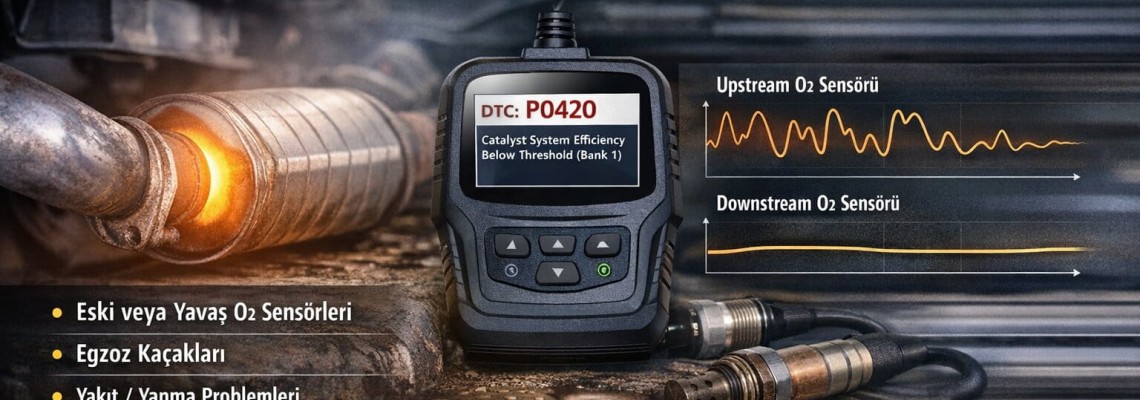
P0420 (Catalyst System Efficiency Below Threshold – Bank 1) is an OBD-II diagnostic trouble code stored when the engine control unit (ECU) determines that catalytic converter efficiency has fallen below the expected threshold.
This code is very common in practice and frequently misinterpreted. The presence of P0420 does not automatically indicate a failed catalytic converter. The code simply means the ECU has detected abnormal post-catalyst exhaust behavior; the root cause may originate from multiple systems.
Code Trigger Logic
The ECU evaluates catalyst efficiency by comparing signals from the upstream (pre-catalyst) and downstream (post-catalyst) oxygen sensors.
Under normal conditions:
The upstream sensor signal fluctuates
The downstream sensor signal remains relatively stable
If the downstream sensor signal begins to resemble the upstream sensor pattern, the ECU interprets this as reduced catalyst efficiency and sets the P0420 trouble code.
Because this decision is based entirely on sensor data, sensor performance and exhaust system conditions are critical factors.
Possible Causes of P0420
In real-world diagnostics, the most common contributors to P0420 include:
Aging or slow oxygen sensors
Fuel trim imbalances
Exhaust system leaks
Misfire or ignition-related issues
Oil consumption and contamination effects
Genuine catalytic converter efficiency loss
Reducing this code to a single component is technically incorrect. In particular, replacing the catalytic converter as a first step often leads to misdiagnosis.
Consequences of Incorrect Diagnosis
Interventions made without sufficient analysis may result in:
Unnecessary parts replacement
Rapid recurrence of the fault code
Time and cost losses
Customer dissatisfaction
Modern vehicles require system behavior verification before component replacement decisions are made.
Critical Checks for Accurate Diagnosis
A structured diagnostic approach for P0420 typically includes:
Live oxygen sensor signal comparison
Short- and long-term fuel trim analysis
Misfire history and combustion data review
Exhaust system leak inspection
Sensor response evaluation
Catalyst behavior confirmation
These steps are essential for determining whether the issue truly stems from the catalytic converter or another subsystem.
How Is P0420 Resolved?
A correct and lasting repair depends on identifying the true root cause. A typical resolution strategy follows this order:
Verify sensor integrity and data reliability
Evaluate mixture control and combustion performance
Physically inspect the exhaust system
Make catalyst replacement decisions only after validation
Replacing the catalytic converter without proper diagnosis carries significant risk.
The Role of Information in Diagnostics
For complex trouble codes such as P0420, accurate results depend on systematic analysis and access to reliable technical references. Fault behavior can vary significantly depending on vehicle make, engine configuration, and ECU strategy.
Data-driven diagnostics should replace assumption-based decisions.