

What is the P0171 Trouble Code? (Lean Mixture) — Causes and Solutions
1. Definition of P0171 Trouble Code
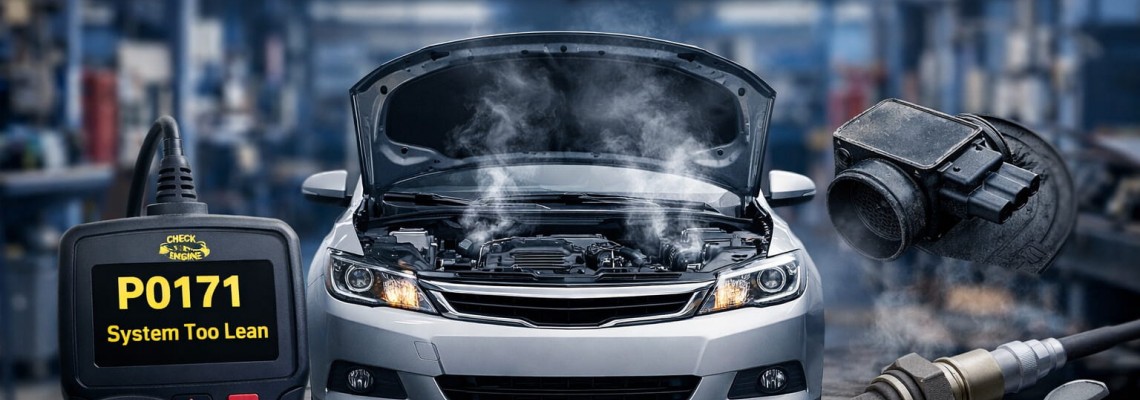
The P0171 trouble code appears when the vehicle’s Engine Control Unit (ECU/PCM) detects that the air–fuel mixture in the engine is leaner than it should be. In other words, the engine receives too much air and not enough fuel (Bank 1).
This is commonly referred to as a “lean mixture” fault.
In simple terms:
The air–fuel ratio is incorrect
The engine does not get enough fuel
Performance and fuel efficiency decrease
The exhaust sensor detects excess oxygen
The ECU cannot correct the mixture, triggering P0171
2. Symptoms of P0171
P0171 usually appears with the following symptoms:
Check Engine Light (CEL) turns on
Engine idles roughly or runs irregularly
Power loss and delayed acceleration
Engine may stall or have difficulty starting
Knocking or overheating from the exhaust
3. Causes of P0171
There are multiple possible causes for the P0171 code. The most common ones for technicians are:
3.1 Vacuum or Intake Leaks
Broken or loose intake manifold hoses
PCV system leaks
These issues allow unmeasured air into the engine. The ECU interprets this as a fuel shortage, causing a lean mixture.
3.2 MAF Sensor (Mass Air Flow Sensor)
If the MAF sensor is faulty or dirty, it sends incorrect air flow data to the ECU. A dirty MAF often triggers P0171.
3.3 O2 (Oxygen) Sensor Malfunction
If the O2 sensor in the exhaust reports incorrect oxygen levels, the ECU applies incorrect fuel trims. The Bank 1 upstream O2 sensor should be checked.
3.4 Fuel System Issues
Weak fuel pump
Clogged fuel filter
Dirty or faulty fuel injectors
Insufficient fuel pressure can trigger P0171.
3.5 Exhaust Leaks
Exhaust leaks can allow extra oxygen into the system, fooling the O2 sensor and making the ECU think the mixture is lean.
4. Correct Diagnostic Steps for P0171
Practical steps for technicians:
4.1 Visual and Basic Checks
Check PCV hoses and intake manifold seals
Listen for hissing or whistling that indicates intake leaks
Ensure the fuel cap is properly tightened
4.2 Clean the MAF Sensor
Remove the MAF sensor and clean it with a proper MAF cleaner. Replace if the problem persists.
4.3 Check Fuel Pressure
Is the fuel pressure at the correct level?
Is the fuel pump delivering enough pressure?
Is the fuel filter clogged?
4.4 Check O2 / Lambda Sensor
Analyze the readings from the Bank 1 upstream O2 sensor. Replace if the measurements are incorrect.
5. Solutions for P0171
The following steps often resolve the code:
5.1 Fix Vacuum Leaks
Inspect and replace intake manifold gaskets if needed
Check vacuum hoses
Inspect PCV valve and hoses
5.2 Clean or Replace the MAF Sensor
Clean the MAF sensor, and if the problem persists, replace it with a quality original part.
5.3 Adjust Fuel Pressure or Replace Components
Replace the fuel filter
Ensure the pump delivers sufficient pressure
Clean or replace injectors as needed
5.4 Inspect O2 Sensor
Incorrect oxygen readings cause lean faults. Older vehicles may need a replacement sensor.
5.5 Check Exhaust Manifold or Upstream O2 Area for Leaks
Exhaust manifold or upstream O2 sensor leaks must be inspected.
6. Conclusion
The P0171 code indicates a lean air–fuel mixture and can originate from multiple components. The best practice is to perform a systematic diagnosis before replacing parts based on assumptions.
7. Technician Tips
Use an OBD2 scanner to analyze long-term and short-term fuel trim values for more accurate diagnosis
If the check engine light returns shortly after clearing, the underlying problem persists