

P0300 Expert Guide: Random Cylinder Misfire
1. Technical Meaning of the Code
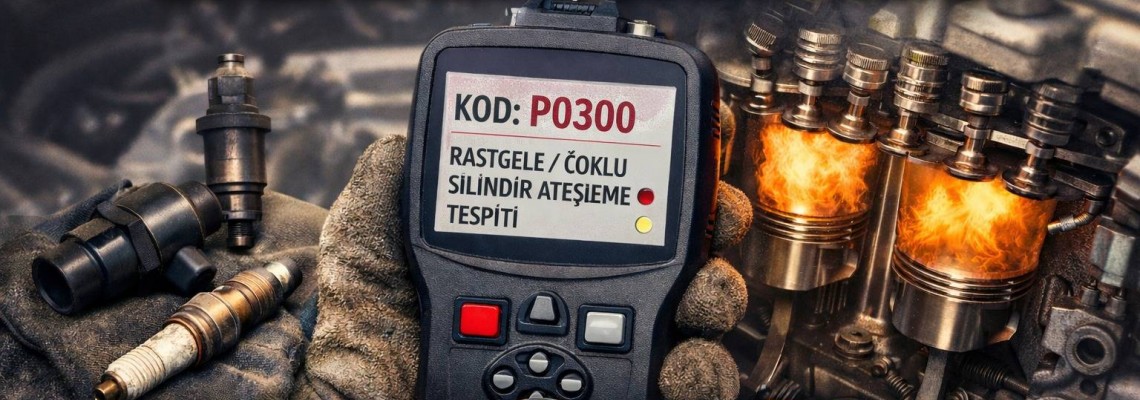
OBD‑II code P0300 is a generic code stored by the Engine Control Module (PCM/ECM) when it detects irregular firing (misfire) in one or more cylinders. If there is no specific cylinder code (P0301–P0308), this code indicates a “random or multiple cylinder misfire.”
A misfire occurs when the piston’s compression, ignition, and combustion cycle cannot proceed normally.
2. Symptoms During Operation
Engine runs rough or vibrates at idle
Loss of power during acceleration
Increased fuel consumption
Check Engine Light is on or blinking
Exhaust may emit black or yellow smoke, unusual noises may occur
Fluctuating engine performance
Note: A blinking Check Engine Light requires immediate attention; the catalytic converter may be damaged.
3. Step-by-Step Diagnostic Plan for Technicians
3.1 Read Codes and Check for Other DTCs
Read P0300 with an OBD‑II scanner.
Check for other P030X codes (e.g., P0301 = cylinder 1 misfire).
If additional codes exist, address them first to streamline diagnosis.
3.2 Electrical and Sensor Checks
Monitor crankshaft and camshaft sensors in live data. Faulty sensors send incorrect signals to the PCM.
If ECM communication or software errors are present, check the module’s CAN bus line, pin connections, and grounds.
3.3 Ignition System
Spark plug check: Worn, carbon-fouled, or incorrect gap can cause weak sparks.
Ignition coils: Faulty coils or wiring cause irregular firing.
Distributor (if present): Worn cap/rotor can cause random spark delays.
Tip: Swapping coils between cylinders can help identify faulty coils or wires.
3.4 Fuel System
Injectors: Partially clogged or electrically faulty injectors may cause misfires.
Fuel pressure: Low pressure causes rich or lean mixtures.
Fuel filter: Clogged filter reduces fuel flow → misfire occurs.
3.5 Air and Intake System
MAF sensor: Faulty readings → incorrect fuel adjustment.
Vacuum leaks: Intake manifold leaks → cylinder mixture imbalance.
EGR valve: Stuck or faulty valve → affects combustion.
3.6 Engine Mechanical Checks
Compression test: Weak cylinders cause irregular combustion.
Valve and piston ring condition: Mechanical weakness can cause misfires.
Fuel quality: Dirty or degraded fuel can hinder combustion.
4. Typical Repairs and Applications
Issue |
Recommended Repair |
|---|---|
Worn spark plugs |
Replace + set correct gap |
Faulty ignition coils |
Test coils → replace if faulty |
Injector issues |
Clean / test / replace |
Low fuel pressure |
Replace pump/filter/regulator |
Electrical faults |
Repair wires, grounds, connections |
Vacuum leaks |
Replace hoses and gaskets |
Sensor faults |
Replace MAF / CKP / CMP sensors |
Mechanical issues |
Perform compression test and internal engine repair |
Service bulletins warn that randomly replacing parts is costly and often ineffective. P0300 alone is not enough to justify replacing all parts; the specific cause must be identified first.
5. Technician Recommendations
P0300 is usually resolved through systematic diagnosis; random part replacement is not recommended.
Document and test each step before moving to the next.
If the MIL is blinking, stop the vehicle immediately and inspect.
Approach the electrical, air, fuel, and ignition systems in blocks.